How Reverse Osmosis Works

Reverse osmosis (RO) is a pressure-driven filtration process that removes dissolved contaminants from water at the molecular level.Reverse osmosis (RO) is a pressure-driven filtration process that removes dissolved contaminants from water at the molecular level.
In natural osmosis, water flows through a semi-permeable membrane from a low concentration of dissolved solids to a higher one. Reverse osmosis applies external pressure to overcome this natural direction, forcing water to pass through the membrane while rejecting impurities.
⚙️ The Core Principle
The RO membrane contains microscopic pores approximately 0.0001 microns in size.
These pores allow water molecules (H₂O) to pass through, while blocking:
- dissolved salts (Na⁺, Cl⁻)
- heavy metals (Pb, Hg, Cd)
- bacteria and viruses
- organic compounds and microplastics
As pressure is applied (typically 3–5 bar), water is separated into two streams:
- Permeate – purified water
- Concentrate – wastewater carrying rejected contaminants
🔄 Filtration Stages Explained
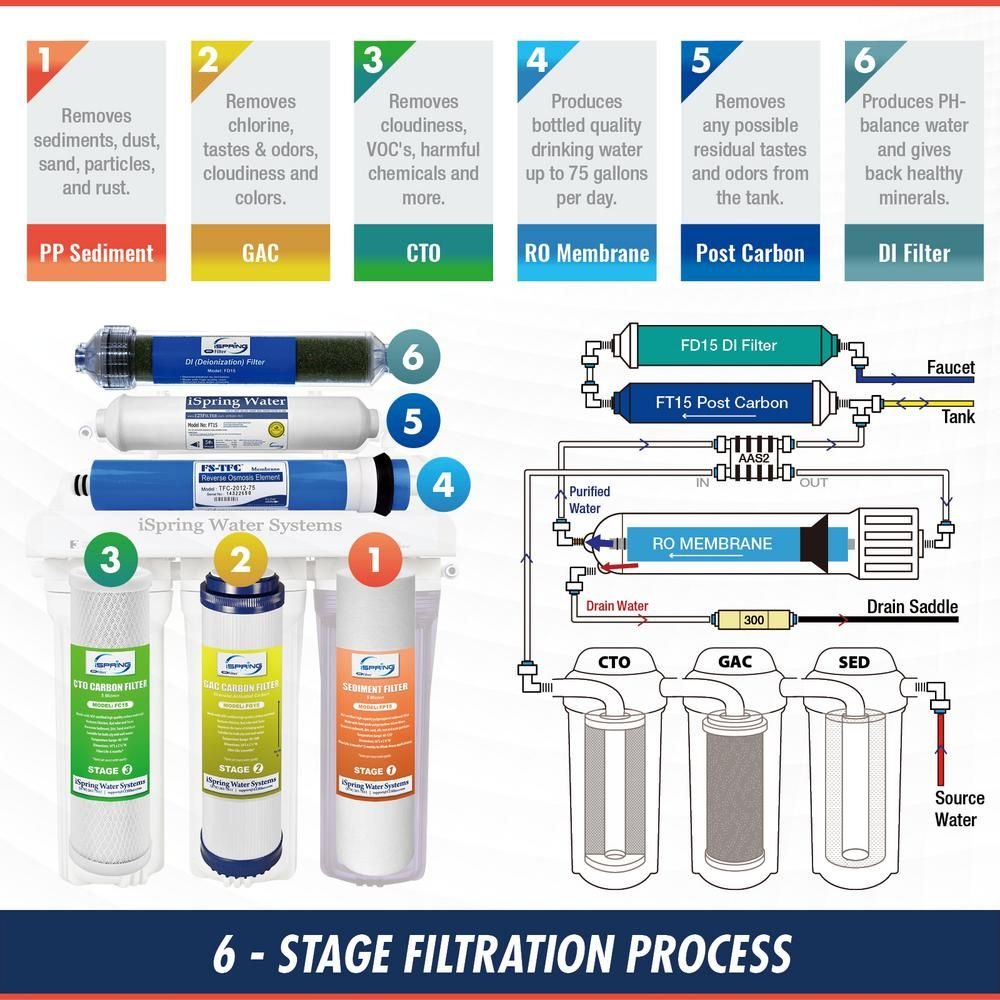
A typical system works in multiple stages:
- Sediment Filter (5–1 micron)
Removes sand, rust, and particles that could clog the system. - Carbon Filter
Eliminates chlorine and organic compounds that would damage the RO membrane. - RO Membrane (0.0001 micron)
The core stage where dissolved solids are separated from water. - Post-Carbon Filter
Improves taste and removes any residual odors.
Optional stages may include remineralization or hydrogen enrichment.
📊 Performance & Efficiency
- Contaminant removal: 95–99%
- TDS reduction: e.g. 300 ppm → 10–20 ppm
- Operating pressure: 2–6 bar
- Recovery ratio: typically 25–50% (depends on system design)
Performance depends on pressure, temperature, and membrane quality.
💧 Why It Matters (Simple View)
Think of reverse osmosis as a highly controlled barrier:
only pure water molecules can pass, while everything else is physically separated and flushed away.
This is not chemical treatment or masking impurities — it is physical removal at the molecular level.
🔍 Real-World Result
What comes out of an RO system is water with significantly reduced mineral content, free from most contaminants, with neutral taste and consistent quality.